Waves Lab
Introduction
A wave can be defined as a disturbance that is caused by a particular source. Waves transfer energy not matter and travel outward through a medium. They transfer the energy through oscillations. There are two different waves: mechanical and electromagnetic. Mechanical waves propagate through matter while electromagnetic don't.
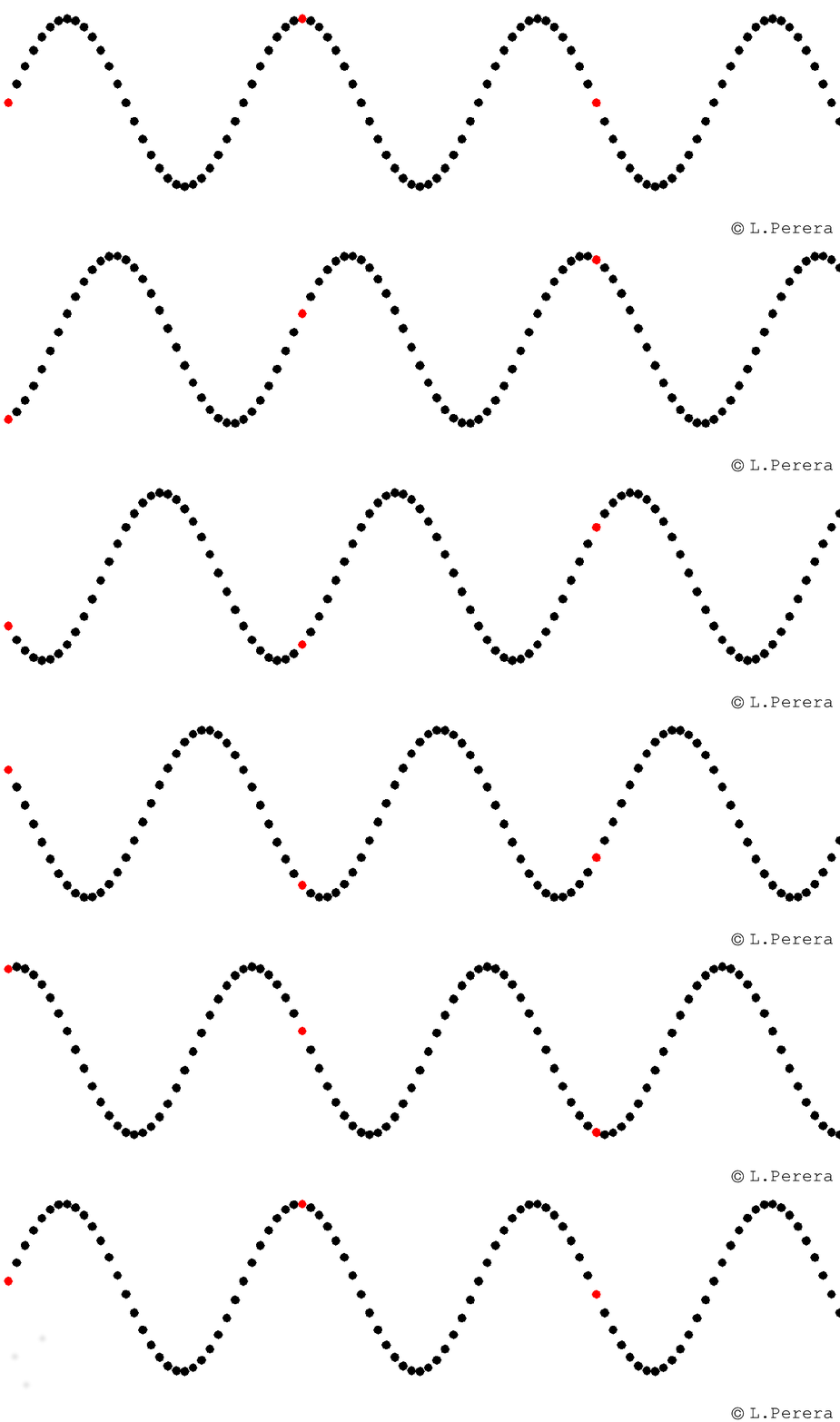
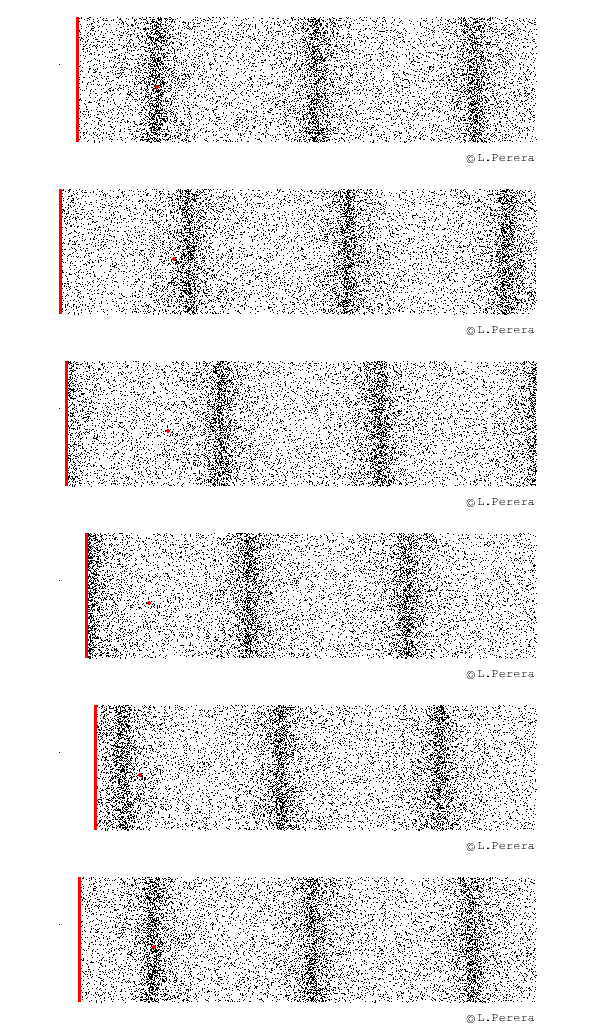
There are two types of waves: transverse (above) and longitudinal (below). In a transverse wave the oscillations are perpendicular to the motion while in a longitudinal wave the oscillations are parallel to the movement.
Wave Investigations

crest
crest
trough
trough
Parts of a Wave
The amplitude is the vertical distance from the equilibrium position to a crest or trough. The wavelength is the distance from one crest to another or one trough to another.
The amplitude of the wave is determined by how much energy the source creates the wave with. For example, if two people were holding a slinky and one created a wave, in order to create a larger amplitude the person shaking the slinky would have to create a larger oscillation. The amplitude is not affected by the frequency (number of oscillations per second) of the wave and the tension of the wave also doesn't affect the amplitude. Additionally it is true that if only the amplitude of the wave is changing, the speed and frequency of the wave won't change. The frequency of the wave is determined by the source. Going back to the example of the slinky, the frequency depends on how fast the person holding the slinky oscillates it.
Note: To measure the amplitude of a transverse wave, calculate distance from equilibrium. To measure the amplitude or a longitudinal wave, use density in the parts of the wave.
Wave Speed
The speed of a wave can be found by multiplying the frequency by the wavelength. However the frequency and wavelength do not determine the speed of a wave. A wave's speed is determined by the medium that the wave propagates through. If the medium doesn't change and therefore the speed doesn't change, the frequency decreases as the wavelength increases and vice versa. In a slinky example, in order to the make the wave speed change, the tension of the slinky has to change. In other words, if a person stretches the slinky out more and creates a wave, the wave speed will change because the medium changed. The more tension in the slinky, the faster the wave moves. The change in medium is an explanation for why the speed of sound is different in air than it is in water or steel.

Wave Speed Equation:
Wave Properties
Wavelength can be defined as the distance between two nearest points in the wave that have exactly the same displacement from equilibrium and are moving in the same direction. As the frequency increases the wavelength decreases because the wave speed remains the same as the medium doesn't change. The amplitude of the wave which is determined by the energy from the source doesn't affect the wavelength.

Superposition of Waves
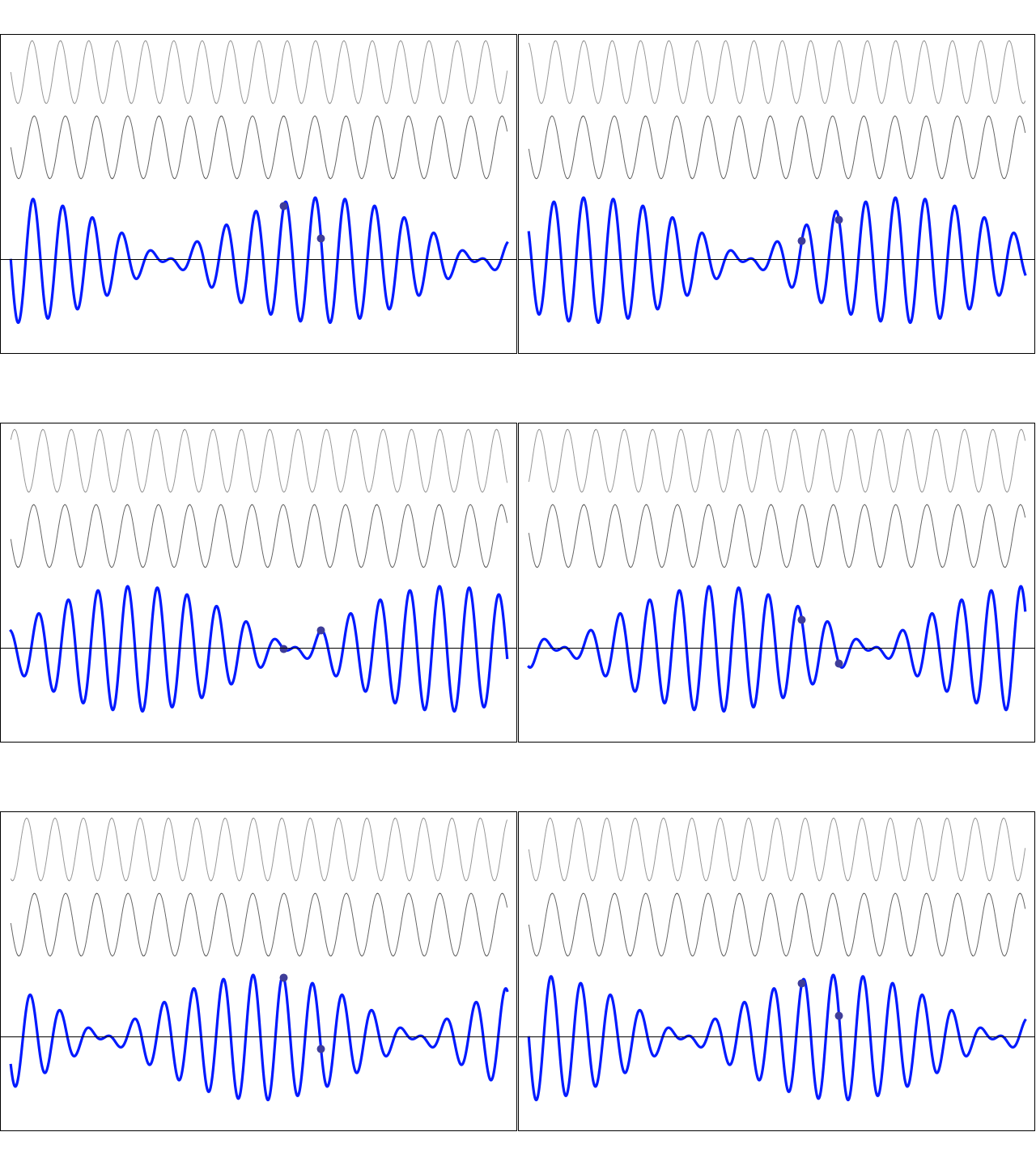
Although if you watch a video of two waves interacting it might seem like they bounce off each other. However waves don't bounce off each other when they interact, they actually move through each other. There are two types of wave interferences: constructive and destructive. Constructive interference is when they build up on each other and the crests and troughs line up. The amplitude increases during constructive interference. In destructive interference, the waves cancel each other out and the crests line up with the troughs.
This shows both constructive and destructive interference
Medium Boundaries
When a wave encounters a boundary there are two cases to explore: either when the end is fixed or loose. When the end is fixed, the wave hits the boundary with a positive amplitude and flips, moving in the opposite direction. The new amplitude is slightly smaller than the original amplitude because some energy is lost but the change in amplitude is not noticeable. In a loose end reflection, the wave hits the boundary and reflects backwards with the same direction and doesn't flip. Because of Newton's Third Law, when the pulse hits the boundary, it exerts an upward pull on it if the amplitude was positive. As a result the boundary exerts a downward pull on the wave and the pulse is reflected with a negative amplitude. Additionally if you have two different mediums that a wave travels through, a more dense medium will have a decrease in amplitude and a less dense will have an increase in amplitude. A practical example of changing boundaries is if a sound wave travels through steel into air. In this case both the speed and the wavelength will decrease.
Standing Waves
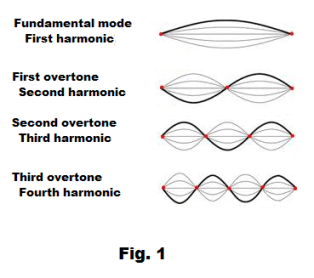
Waves can either be traveling or standing waves. Traveling waves move from one place to another while standing waves appear to "stand still". Going back to constructive and destructive interference, on standing waves nodes are caused by destructive interference while antinodes are created by constructive interference. Nodes are areas in which the wave isn't moving and antinodes are areas in which the standing wave is moving. Once the source reaches a certain frequency it creates a standing wave. The fundamental frequency of a standing wave is when the whole string is vibrating. In a standing wave, the wavelength is determined by the boundary (L) and the frequency. As you move up in harmonics, the wavelength decreases and the frequency increases. There are different types of standing waves though: closed - closed (violin string), open - closed (trumpet) and open - open (flute).
Speed of Standing Waves
Regarding the speed of standing waves, the tension and linear density do affect the speed. The relationship between these three is shown in the equation to the right. As the tension increases, the speed of the standing wave increases as well. A good way to visualize this is thinking of a violin string. If you tune the string higher which means you make it more tense, then you create a higher frequency which increases the wave speed.